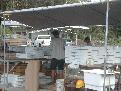
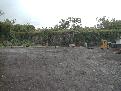
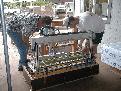
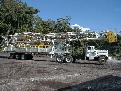
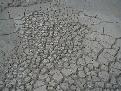
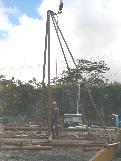
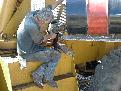
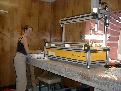
I'm afraid that transmission of the most recent update (#3 distributed earlier this week) was delayed a bit by the images. The current status is that the equipment left the west coast late last week and is now on its way to Hawaii. For those of you into the details, this morning the barge was reported at: 36 57N 124 17W We did encounter a minor scheduling glitch with offloading - the stevedores are otherwise engaged on our planned offloading date so we will be offloading the barge on April 15 rather than April 10 as initially planned. Site prep is pretty well complete and we will begin setting up support facilities during the next week or so. Bruce Howell, our "Engineer Extrodinaire" will arrive next week and oversee the last details of site prep, crane rigging, trucking arrangements and local crew interviews. Although we were concerned about availability of a local crew - because the island's geothermal company was planning to drill several new holes this year - they unexpectedly shut down their drilling early and it looks like we will have a number of experienced drilling hands to choose from for our relief crew.
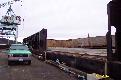
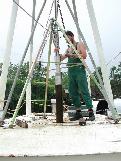
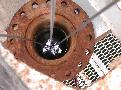
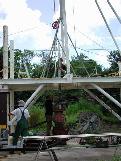
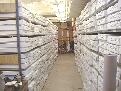
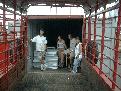
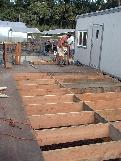
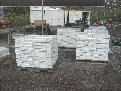
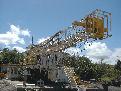
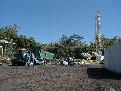
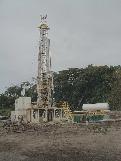
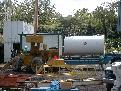
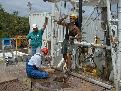
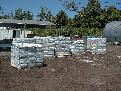
The rig and ~25 truckloads of hardware were successfully transported to Tacoma, WA this week and are waiting to be loaded onto the barge (see photos). The barge is scheduled to leave late next week and we are planning to receive it here in Hilo on April 9. Offloading is scheduled for April 10 with trucking directly to the site from the barge. Progress is being made at the site to ready it for starting up operations. We will have a temporary office set up in about 10 days - and will begin the dozer work for placing the water tanks and mud tanks next week. Pray for good weather coming across the Pacific ....
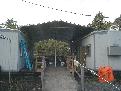
As of the present date, we have finalized shipping arrangements and most of the drilling equipment is currently in transit to Tacoma, Washington. The scheduled date of departure from Tacoma is 3/24 with arrival in Hilo on 4/9. Bruce Howell and the rig-up crew will arrive on 4/8 and will finalize the site design and be ready to begin rig-up on 4/10. Between now and 4/9, the Hawaii crew we will be completing as much of the site clearing and set-up as we can before the rig arrives.
As of the present time, the rotary rig modifications are nearing completion and materials are being assembled in Rexburg, Idaho in preparation to shipping the major equipment items to Hilo. We are currently expecting a shipping date during the third week of March with arrival of the equipment in the first or second week of April. Shipping arrangements are still being worked out - and these dates may still slip by up to two weeks. With the arrival of the hardware in Hilo, rig-up of the rotary drilling equipment will begin immediately; we expect that the first two weeks of operation will be occupied by rig-up and shake-down of the rotary equipment. Our first down-hole task will be an effort to repair a leak in the casing - that may take several days but, by the end of the first week of May, we expect to begin hole opening. This process will require between 30 and 60 days to complete: the actual duration will depend on stability of the hole and our ability to straighten the "dog-leg" that developed below about 9000' near the end of the first phase of coring. We expect to open hole to a depth of 10,500' to 11,000' (3200 m - 3300 m) depending on where we encounter stable formation for cementing the casing in place. At the completion of the hole opening, we are planning to stand-down the rig crew for a week to ten days to give the crew a break - and to allow the down-hole logging crew to perform any downhole measurements that are desired by the various interest groups. At the end of that period, we will do a final clearance run with a rotary bit and then set and cement the 5" casing in the bottom of the borehole. At the completion of that operation, coring will commence. I will try to provide weekly updates until the drilling equipment is on site and rigged up; after that, I will make every effort to provide updates on a daily basis. As each of the major milestones is passed, I will be able to give better estimates of the dates for subsequent actions/events.
We started to get out the packer-system after 14 days of nearly continuous measurements of temperature with the fibre optics. The last temperature/pressure-log will close the measurement campaign tomorrow.
Yesterday, we set the packer at 380 m. Now we measure the pressure and temperature (below and above the packer) as well as the temperature of the complete borehole up to 2095 m with the fibre optical cable.
We inflated the packer at 178 m, but the borehole is still flowing on the surface. Therefore, we got our equipment out of the hole and stopped at several depths to try to find the casing break. Finally, we figured out that it should be between 100 and 140 m, because water flow stopped at a packer depth of 100 m.
Today, we tried to install the packer below the expected casing break at 380 m. Unfortunately, we could not reach more than 178 m, because we hang up with the equipment at that depth.
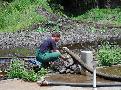
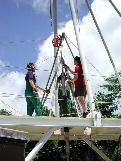
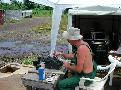
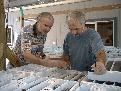
3 members (Grit Dannowski, Mathias Poser and Joerg Schroetter) of GFZ petrophysics and geothermics group and a guest scientist of the Technical University Berlin (Guenter Zimmermann) prepare the equipment for a hydraulic experiment at the HSDP2 site.
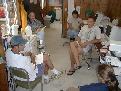
The Core Logging Crew packed up four pallets worth of working boxes. We await the arrival of Ed Stolper, who will sample the last batch of core on-site.
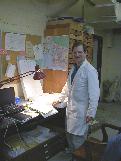
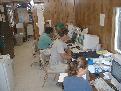
The geology crew is busy wrapping up loose ends at the site-- instruments are being packed away, corrections are being made to the database, and summaries of site activities are being prepared.
The geology crew is logging core from around 9900'-- just where the hole began to get unstable. We are seeing lots of highly fractured, strongly altered rocks.
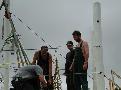
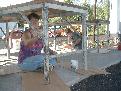
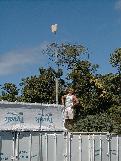
David Whilldin tries to restore our connection to the outside world by installing the antenna for the wireless bridge on top of one of our storage containers. Unfortunately, the antenna is still not high enough to reach the University of Hawaii over the tops of the trees, so we remain isolated.
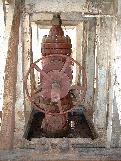
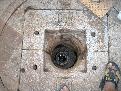
The well is barely trickeling these days. Heavy mud that drillers pumped down to kill the well is still keeping the flow to a minimum. The slow trickle we have been seeing lately is probably coming from around 400' depth.