
A deep Geophysical Observatory at the North Anatolian Fault
Project Acronym: GONAF | State: Completed | Expedition ID: 5039
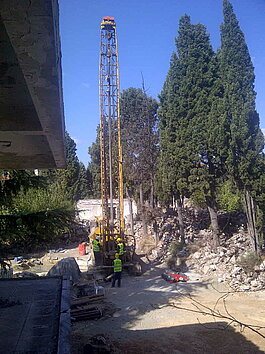
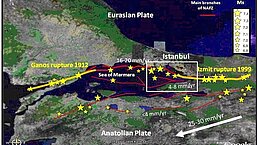
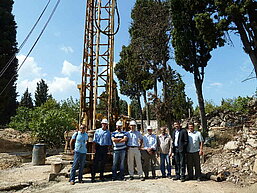
The GONAF project involves the installation of a high-resolution borehole seismic observatory at the North Anatolian Fault Zone (NAFZ) consisting of several shallow (up to 500 m deep) vertical boreholes in onshore locations around the eastern Sea of Marmara/NW Turkey. The principal scientific objective is to study physical processes acting before, during and after the expected M>7 earthquake along the Princes Islands segment of the NAFZ by monitoring microseismic activity at significantly reduced magnitude detection threshold and improved hypocentral resolution. It is also intended to study wave propagation characteristics of a large earthquake using downhole seismic recordings at different spots along the potential rupture.
Besides 7 ICDP funded boreholes for seismometers, additional 4 shallow boreholes (each 150 m deep) for the installation of strainmeters were drilled with additional funds.
Keywords: Asia, Turkey, Istanbul, Northern Anatolian Fault Zone, Active Faulting, Borehole Observatory, Earthquake Physics, High-resolution Seismic Monitoring, Seismic Hazards

Project Management
Project Details
Project Location
Project Timeline
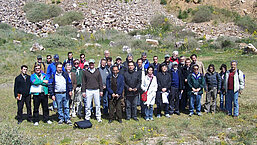
Post Drilling Workshop
20 May 2015 in Potsdam, Germany
Monitoring
20 May 2015 - ongoing
Drilling
12 September 2012 - 20 May 2015
Full Proposal Approved
First Full Proposal Submitted
Workshop Held
23 - 27 April 2007 in Istanbul, Turkey