
Deep Fault Drilling Project
Project Acronym: DFDP | State: Completed | Expedition ID: 5052
The mid-crust is the locus of several fundamental geological and geophysical phenomena: these include the transitions from brittle to ductile behaviour and from unstable to stable frictional sliding; earthquake nucleation and predominant moment release; the peak in the crustal stress envelope; the transition from predominantly cataclastic to mylonitic fault rocks; and mineralisation associated with fracture permeability.
The Alpine Fault, New Zealand, is a globally significant dextral-reverse fault that is thought to fail in large earthquakes (c. Mw 7.9) every 200-400 years and last ruptured in 1717 AD. Ongoing uplift has rapidly exhumed a crustal section from c. 20 km, providing a young (<1 Myr), well-preserved sample of mid-crustal structures currently active at depth.
Keywords: Oceania, New Zealand, Active Faults, Alpine Fault, Brittle, Ductile, Seismogenic Zone


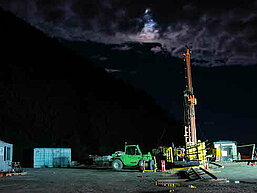
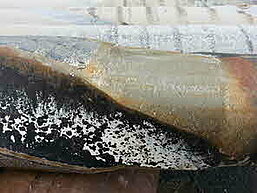
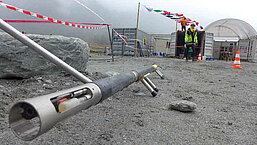

Project Management
Contact Person
Lead PIs
CoPIs
Co-PIs: No data found
Project Details
Project Description
- Title:
- Deep Fault Drilling Project (DFDP), Alpine Fault, New Zealand: Phase 2 - conditions at 1.5 km depth (DFDP)
- Proposed in:
- 2011
- Current State:
- Completed
- Proposal abstract:
- n.a.
- Geologic age:
- Quaternary
- Number of drillsites (drillholes):
- 2(4)
- Drilled length:
- 1287.38 m (4 wellholes/hole attempts/hole deepenings/sidetracks total)
- Cored length:
- 310.98 m
- Core recovered, length:
- 159.33 m
- Core recovered length / Cored length:
- 51.2%
- Core recovered / Drilled length:
- 12.4%
- Expedition #
- 5052
- Location
- Oceania, New Zealand, South Island, Alpine Fault, New Zealand
- Coordinates
- -43.0000, 170.0000
- Status
- Completed
Project Location
Project Timeline
Drilling
5 October - 18 December 2014
Full Proposal Approved
Workshop Held
22 - 28 March 2009 in Franz Josef Glacier, New Zealand