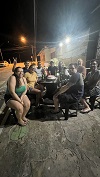
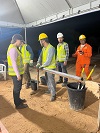
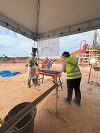
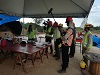
While the team waits for the cement to dry, Angela leads the on-site team in making pasta and guacamole with tacos. Angela Jimenez is from Honduras and completed her doctoral studies in Brazil.
The on-site team was requested to perform Caliper downhole logging at critical depths. An enlargement of at least 52 cm in diameter and 2 m deeper below the shoe was identified. GEOSOL decided to cement the top of the overwashed section that accumulated the gravel and filled the annular space.
GEOSOL strengthens the awareness campaign, whose main goal is to alert women and society about the importance of prevention and early diagnosis of breast cancer and cervical cancer. The pink lace on the doghouse is a symbol present at the drill site.
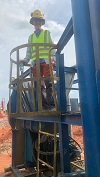
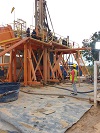
The drag bit did not clean the complete section. GEOSOL requested from the headquarter in Minas Gerais state the shipment of a tricone drill bit. The bit was machined to pass through the 4 15/16” drill pipe. In the photo, the drill passes through the template to ensure that it has free passage through the drill pipe. The tricone should reduce the size of the clasts and have better efficiency in cleaning the well.
Larissa returned to the drill site and assisted in core handling operations. She brought delicious items for the team in her luggage. We loved the coffee, candies, and cookies. Larissa has been crucial in managing the field team.
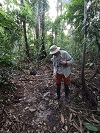
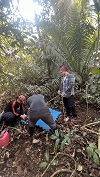
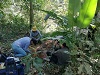
Professor Marconato arrives and leads a team for the description of sedimentological profiles and sampling in an outcrop with overlapping layers of paleosoil in the Profeta village. Prof. Negri is excited to learn new techniques and assist in the sampling.
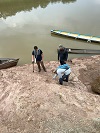
While Geosol performs the drill pipe take-off operation, Professor Felipe Figueiredo leads a team to a sedimentological description of modern sandbars on the river banks along the Juruá River. Professor Felipe is a postdoctoral researcher studying modern bars and assisting in facies modeling of the geological record of large rivers.
Angela Jimenez leads the day shift and oversees the core handling activities of Larissa Tamura and Alderlene Brito. Remember that the red tape is always at the bottom end.
Slickensides form in soil with significant amounts of shrink-swell clays—a smoothly polished surface caused by frictional movement related to expansion and contraction along cracks.
When there is a break in drilling activities, Professor Renato and Professor Felipe visit and describe outcrops, learning about the geology and architecture of the deposits in the region. In the Profeta Village, there are outcrops of reddish mudstone with carbonate cement intercalated with bodies of sand with lobate geometry and undulating bases.
Professor Renato Almeida from the University of São Paulo and Professor Felipe Torres from the University of Sergipe arrived to assist Isaac Bezerra in core handling activities and in communication with Geosol management on site, providing updates to the executive committee.
Professor Negri has been crucial in planning drilling activities in the Acre Basin. He has contributed to advancing research in paleozoology in the state of Acre since 1988. His energy and dedication to work during corehandling activities are contagious.
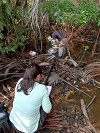
Pieces of wood debris are primarily fibrous or flaky. The sand associated with them is high sulfur (S) coal linked to the organic matter itself, a phenomenon commonly observed in coal deposits. Discussions are ongoing regarding the occurrence of high-sulfur coal deposited in brackish environments or not.
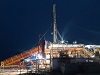
Sunset on the outcrop along the riverbank exposure in the Rodrigues Alves city, right margin of the Juruá River.
The stratigraphic description helps to understand the geometry of the sand bodies cored on the drill site.
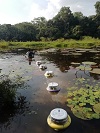
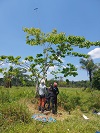
While the drilling company is finishing the cementation phase, the team on site is conducting fieldwork on fluvial terraces near the drill site city.
These fluvial terraces are an important piece for understanding the evolution of the landscape of western Amazonia.
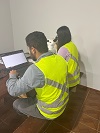
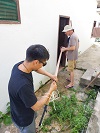
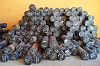
After the project manager's inspection, the condition of the core samples stored in the warehouse is being discussed.
The executive committee is concerned that it may be microbial growth. However, the dark coloration is related to the decomposition of the drilling fluid.
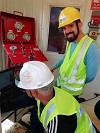
The caliper probe was used to check for overwash below the stuck pipeline. An overwash section was identified, and cementing is required.
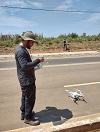
None of the team members in the operation are geophysicists. The team on site received online guidance from geophysicist Tacio Bicudo.
Today we had visitors from Germany for the channel “ZDF Info” in the series "Wonders of Nature - on the traces of the history of the Earth" and we showed them our day-to-day life at the drill site.