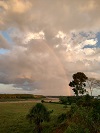
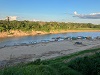
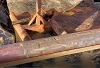
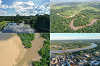
During dry season the Jurua looks like this. During wet season it can be 10 meters higher and fills this wide valley.Our drill site is about 600 meters west of the Petrobras site. As we reach 560 meters below the surface we still encounter similar paleo-environments to those seen in the photo of the modern Jurua: floodplain, point bar, channel. Nothing changes; changes are constant.
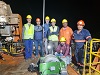
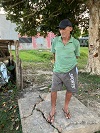
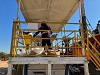
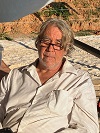
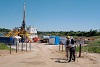
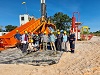
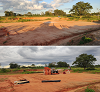
In 1961, when this man was a 19 year old, Petrobras drilled a deep exploratory well right where he is standing. Today the site sits less than two meters away from the edge of the top of the high terrace overlooking the Jurua River, one of the major tributaries of the Amazon.
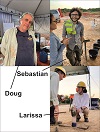
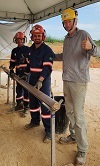
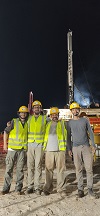
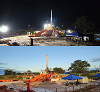
At our Acre drill site, team members and drillers are being swapped in and out. Yesterday we gained Larissa Tamura, a geophysics postdoctoral from USP. And tonight we lose Doug Schnurrenberger our drilling supervisor from University of Minnesota and Sebastian Gómez, a Colombian doctoral student at USP. Doug and Sebastian have been at the site for the past month and have been invaluable, for both their talents and their personalities.
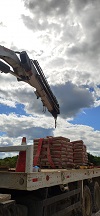
This is filled with cuttings from the drill core. It is emptied into a nearby, on-site, mud pit. Basically bits of rock from depth are buried at the surface. No harm done.
By the way, our drill site is on an abandoned Moto-cross course. No trees cleared.
With our continuing interbedded sand and hard, expanding muds, recovery requires constant vigilance by the drillers and thoughtful composition of drilling mud.
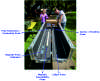
There is a little informational video of the core being extruded from the core barrel into the split liner (click here for the video). The method has made a huge difference in recovery.
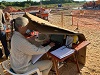
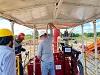
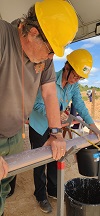
Catherine Rigsby working in the makeshift shade against the early morning sun. We are really happy when cloud cover appears. Otherwise, some pretty hot days. Make those European heat domes seem like child's play:).
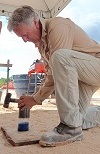
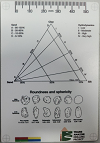
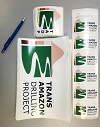
The TADP has its own grain size card. This will be used by researches as a particle size reference scale during the description of samples. But they will also be distributed to local secondary school teachers, so they can use them in their classes. We have them in english and portuguese.
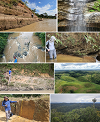
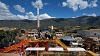
The inventory of geosites lists the sites with great geoscientific importance of an area. Together with the drilling, an assessment of geosites from the Juruá River region in Acre is being conducted. The inventory can be used as a tool of management, conservation and public policy.
Drone imagery from different sites along the Acre basin is being used in virtual tours. Immersive and built for virtual reality they're impressive and are comming soon....
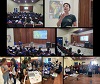
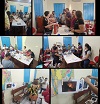
in May the Outreach team conducted lectures in the municipality of Rodrigues Alves to present Geosciences topics to students and teachers of local secondary schools. In the occasion the project manager also presented the TADP and its main purposes.
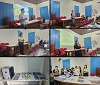
in May the Outreach team and professors from the Federal University of Acre conducted a 2 day Geosciences training course in Cruzeiro do Sul. In the second day Acre-related topics were discussed and then the group visited the laboratories of the University of Acre to learn about paleontology and palinology techniques.
Outreach: in May the Outreach team and professors from the Federal University of Acre conducted a 2 day Geosciences training course in Cruzeiro do Sul for secondary school teachers, government officials and environmental agency employees. In the first day a series of Geology topics were discussed.
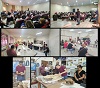
in May the Outreach team conducted a public talk in the municipality of Cruzeiro do Sul to officially present the TADP to members of the local governments, secondary school teachers, and environmental agency employees. The meeting was concluded with a practical activity: seeing sand samples from the different amazonian rivers in the microscope!
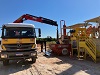
The drill rig was assembled and tested. Soon it will be transported on trucks from the state of Minas Gerais to Acre. A distance of ~4400 km, equivalent to a trip from Lisbon in Portugal to Moscow in Russia.
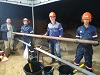
Geophysical acquisition is a vital part of the drilling operation. Today a set of instruments were tested in the University of São Paulo to guarantee that the TADP will be problem-safe.
Scientists from the TransAmazon ICDP Project, the ICDP data management team and LacCore staff prepare the sample and data management for the project. The training is currently taking place at LacCore in Minneapolis, the TransAmazon drilling is scheduled for Summer 2020.