
Thawing of permafrost and cryosphere-associated gas hydrates by Arctic warming
Project Acronym: THAW | State: Workshop Approved
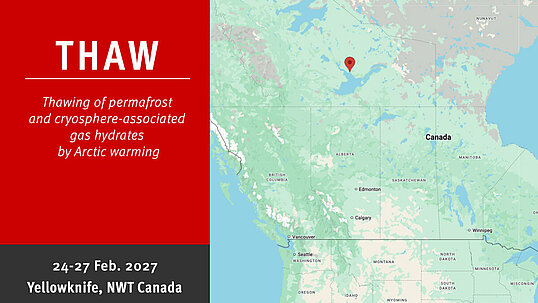
This workshop proposal addresses gas hydrates (GH) and permafrost-related questions under current and future global warming scenarios with a regional emphasis on the Canadian Mackenzie-Beaufort region (CMB). The Canadian Mackenzie-Beaufort region (CMB) is an optimal site to serve as a representative Pan-Arctic location, and has benefited from past industry and scientific drilling activity. The workshop will yield a set of preferred drill-site locations of a L2S transect, define site-specific science targets and sampling strategy, and will lay the foundation for a full drilling proposal by incorporating representatives from Canadian regulatory agencies and indigenous groups.
The scientific underpinning of the proposal is based on vast regions of the Arctic continental margins having been either subaerially exposed or iced covered during glacial times with annual mean temperatures of around -20°C, resulting in vast regions with on- and offshore permafrost. This permafrost hosts methane as either free gas, dissolved in unfrozen water, and as GH. Current estimates of methane in GH in Arctic regions are speculative, ranging from 27 to over 540 gigatons, which corresponds to up to 1500 times the annual anthropogenic and natural methane emissions. Global warming changes the P-T conditions and thus endangers the stability of GH, which poses the risk of methane being released into the atmosphere, further amplifying climate change. As permafrost warms, changes in permeability create pathways for gas migration to the surface. GH dissociation may also amplify ground destabilization and thus pose future risks to infrastructure and human health and widely affects all ecosystems. Since the Arctic is warming faster than the rest of the planet leading to drastic and cascading environmental impacts, the scientific objectives of this proposal also bear high social relevance. The response of permafrost and GH varies according to its local setting. Terrestrial occurrences respond to surface temperature changes while offshore occurrences respond to the history of transgression and warming of bottom water temperatures; thus, a L2S drilling transect is required to understand the distribution of permafrost and GH, the temporal evolution of the cryosphere, and defining the fate of carbon within these systems.
KEYWORDS: North America, Canada, Arctic Regions, Methane Hydrates, Permafrost, Climate Change

 PRESS/MEDIA RELEASES | PUBLICATIONS | WORKSHOPS | INTERNAL DATA
 PROJECT SOCIAL MEDIA
Project News & Gallery
Project News
updates & project highlights
Project Management
Contact Person
Lead PIs
- Michael Angelopoulos – Technical University of Munich
- Stefan Bünz – The Arctic University of Norway
- Ann Cook – The Ohio State University
- Scott Dallimore – Geological Survey of Canada
- John Hopper – Geological Survey of Denmark and Greenland
- Laura Lapham – University of Maryland
- Paul Overduin – Alfred-Wegener-Institut Helmholtz-Zentrum für Polar- und Meeresforschung
- Alexey Portnov – Consejo Superior de Investigaciones Cientificas
- Umberta Tinivella – Istituto Nazionale di Oceanografia e di Geofisica Sperimentale
- Birgit Wild – Stockholm University
Project Details
- Title:
- Thawing of permafrost and cryosphere-associated gas hydrates by Arctic warming (THAW)
- Proposed in:
- 2026
- Current State:
- Workshop Approved
- Proposal abstract:
- n.a.
- Geologic age:
- Neogene, Paleogene
- Number of drillsites (drillholes):
- n.a.
- Drilled length:
- n.a.
- Cored length:
- n.a.
- Core recovered, length:
- n.a.
- Core recovered length / Cored length:
- n.a.
- Core recovered / Drilled length:
- n.a.
- Location
- Canada
- Coordinates
- 72.0000, -137.0000
- Status
- Workshop Approved
- Internal ID
- ICDP-2026/23 (#2181)
- Expedition acronym
- THAW
- ICDP ID
- ICDP-2026/23
- Internal ID
- #2181
- Proposals ID
- 5347