
The Hominin Sites And Paleolakes Drilling Project: Using Scientific Drilling to Understand the Paleoclimate Context of Human Evolution
Project Acronym: HSDPD | State: Completed | Expedition ID: 5053
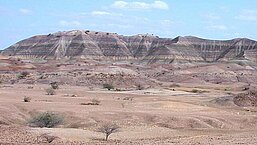
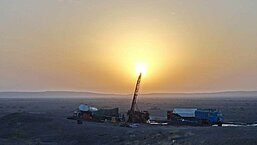
The HSPDP drilling project considers the scientific opportunities and technical challenges of obtaining sediment cores from several of the most important fossil hominin and early Paleolithic artifact sites in the world, located in Kenya and Ethiopia. Our objective is to drill in near-continuous sedimentary sequences close to areas of critical importance for understanding hominin phylogeny, covering key time intervals for addressing questions about the role of environmental forcing in shaping human evolution. These sites are all currently on-land, but consist of thick lacustrine sedimentary sequences with high deposition rates. Therefore, the proposed sites combine the attributes of relatively low cost targets (in comparison with open water, deep lake sites) and the potential for long, highly continuous and informative paleoenvironmental records obtainable from lake beds.
Keywords: Africa, Ethiopia, African Rift, Climate Dynamics, Global Environment, Hominin Evolution, Paleoclimate
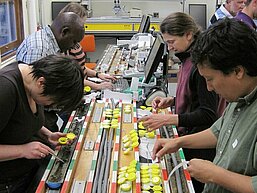
Cores are stored at University of Minnesota at Minneapolis, Continental Scientific Drilling Facility, USA
Project Management
Contact Person
Lead PIs
- J. Arrowsmith – Arizona State University
- Asfawossen Asrat – Botswana International University of Science and Technology
- Anna Behrensmeyer – Smithsonian Institution
- Christopher Campisano – Arizona State University
- Craig Feibel – Rutgers University
- Shimeles Fisseha – University of Addis Ababa
- Roy Johnson – University of Arizona
- John Kingston – University of Michigan
- Henry Lamb – Aberystwyth University
- Emma Mbua – National Museums of Kenya
- Daniel Olago – University of Nairobi
- Richard Owen – Hong Kong Baptist University
- Richard Potts – Smithsonian Institution
- Robin Renaut – University of Saskatchewan
- Frank Schaebitz – University of Cologne
- Jean Tiercelin – Universite de Rennes 1
- Martin Trauth – University of Potsdam
- Mohammed Umer – University of Addis Ababa
- Giday WoldeGabriel – Los Alamos National Laboratory
Project Details
Project Description
- Title:
- The Hominin Sites and Paleolakes Drilling Project (HSPDP): Using Scientific Drilling to understand the Paleoclimate Context of Human Evolution (HSPDP)
- Proposed in:
- 2010
- Current State:
- Completed
- Proposal abstract:
- n.a.
- Geologic age:
- Pliocene/Pleistocene
- Number of drillsites (drillholes):
- 6(13)
- Drilled length:
- n.a.
- Cored length:
- n.a.
- Core recovered, length:
- n.a.
- Core recovered length / Cored length:
- n.a.
- Core recovered / Drilled length:
- n.a.
- Expedition #
- 5053
- Location
- Africa, Eastern Africa, Kenya, Ethiopia, Eastern Rift Valley, Kenya, Ethiopia
- Coordinates
- -2.0000, 36.0000
- Status
- Completed
Project Location
Project Timeline
Drilling 4
6 - 30 November 2014
Drilling 3
11 June - 10 July 2014
Drilling 2
23 February - 31 March 2014
Drilling 1
1 June - 31 July 2013
Full Proposal Approved
Workshop Held
17 - 21 November 2008 in Addis Ababa, Ethiopia